
Arkansas Has No Public ACIC Warrant Search
Arkansas has no public statewide active-warrant search and no public e-warrant repository. The Arkansas Crime Information Center (ACIC) provides restricted criminal-justice information services, including access to the National Crime Information Center (NCIC). Authorized justice users run those systems. ACIC itself says the restricted information is not a public self-service product, and a Freedom of Information Act request will not generally open it either. ACIC will not run a name search for you. That call belongs to the issuing court. The ACIC secure services portal stops at an authorized login. That gate is not a public warrant index. The official page shows the login requirement itself.
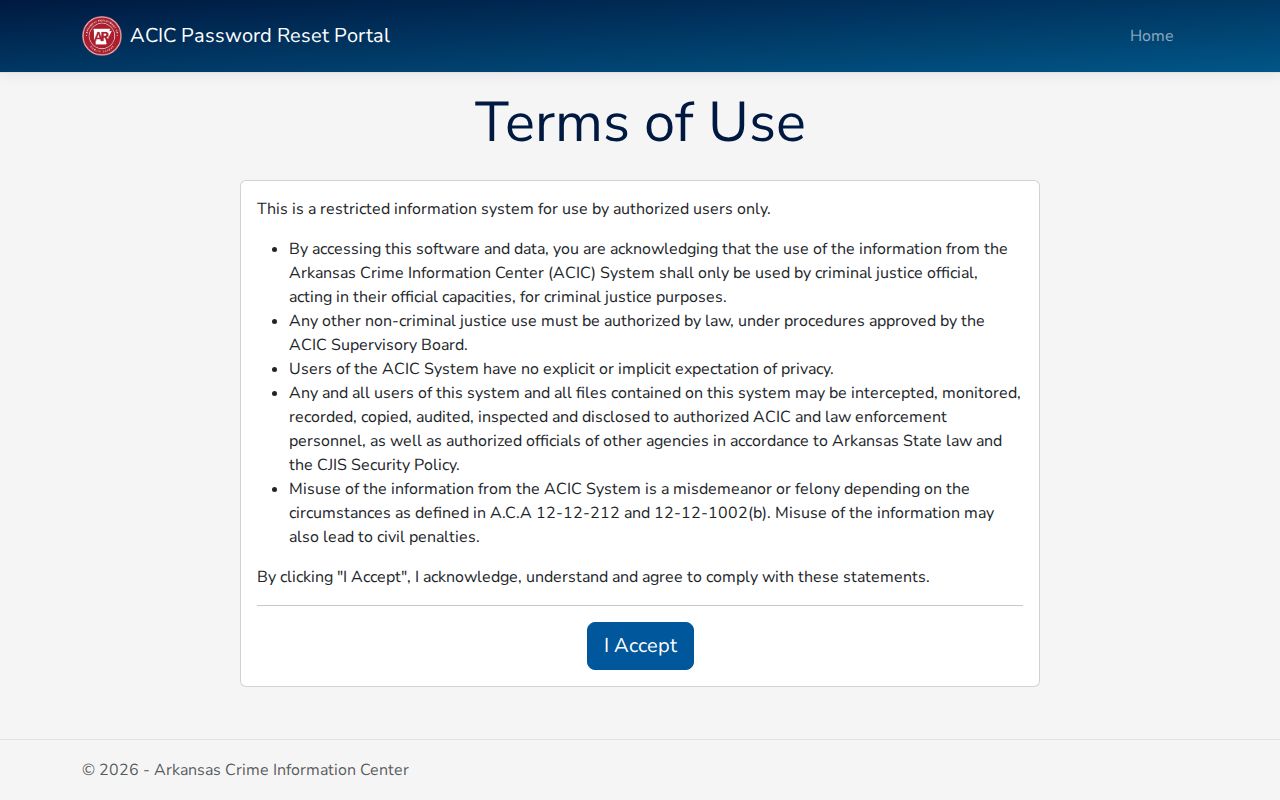
The login screen proves only that access is restricted. It offers no search fields for an individual lookup. For an open Arkansas case, use a public court channel. Confirm warrant status with the local court and agency holding the record. For ACIC access limits, read its official FAQ. That boundary is a system limit, not a signal that an Arkansas warrant does or does not exist.
How Arkansas Warrants Are Tracked
Every Arkansas warrant begins life inside a court case. A judge or magistrate issues the order under the rule for that matter. The clerk records it. The sheriff or another authorized officer handles service. Felony cases and other general-jurisdiction matters go to Circuit Courts. District Courts take traffic, misdemeanors, local ordinances, preliminary felony matters, and limited civil claims. A city court function can operate within the District Court structure. Which clerk keeps a lower-court record varies locally. ACIC and NCIC move information among authorized justice agencies only. They are not public warrant lists. Search ARCourts offers some court-case information, yet it is not a warrant index, and some District Court information is missing. The case and service record stay with the local court and its assigned agency. Use Browse Counties to find the right Arkansas office for a specific order. Then contact that court and the sheriff serving that county.
Arkansas DPS, ACIC, and ASP Have Different Roles
Inside the Arkansas Department of Public Safety (DPS) sit both ACIC and the Arkansas State Police (ASP). Their jobs do not overlap. ACIC handles criminal-justice information services, manages authorized access relationships, and supports ACIC/NCIC use. It publishes no statewide warrant roster. It also cannot clear a court order for anyone. Agency agreements decide who may reach the records and who must maintain them. ASP performs statewide law-enforcement and investigative work. It joins fugitive task-force operations too. Its public materials offer no general warrant search. There is no ASP warrant-status desk. The Administrative Office of the Courts (AOC) runs court technology and rules. It gives the public Search ARCourts for case access and eTraffic for citation functions. Neither is an all-warrant repository. A question about a local order belongs with the issuing court and its serving agency. ACIC's public contacts cover its own services and access rules. See the official Arkansas State Police page for its services and task-force role. Note: ACIC supports authorized system use; it does not decide whether a local judge should issue, recall, or quash an order.
No Statewide Arkansas Warrant Amnesty Was Located
Arkansas runs no statewide annual warrant-amnesty or universal recall program. A city or county may still announce a temporary event for certain courts or case types. Its date, eligibility, registration, payment terms, and need for a judge's approval are all local. An event label alone cannot tell you whether a warrant will be recalled or a license status changed. Read the current notice from the court or sheriff on the case. Then ask the issuing clerk whether the order is covered and what proof shows completion. A time-limited event never replaces the ordinary court, bond, appearance, or motion process. Cases outside its scope still follow the usual Arkansas court route. Use Browse Counties to pull up the local court and sheriff contacts for that Arkansas county.
The Arkansas Warrant Database
No public Arkansas warrant database searches every county. Several separate tools get mistaken for one. The table sorts out restricted criminal-information systems, public case access, and a citation-payment service.
| System or Tool | What It Covers | Operator or Custodian |
|---|---|---|
| ACIC services | Restricted criminal-justice information access and agency data services | ACIC within Arkansas DPS |
| NCIC | National justice-information records available to authorized users | FBI Criminal Justice Information Services |
| Search ARCourts | Public case and docket information where the court data is available; not a warrant index | Arkansas Judiciary and AOC |
| eTraffic | Citation search and payment for participating courts; not a warrant index | Arkansas Judiciary and AOC |
A restricted system serves police, not the public. It can carry a warrant record with no search screen for you. A public docket can expose a case but hide warrant events. Users, coverage, and legal limits all differ.
Arkansas Court Levels Shape the Warrant Record
Arkansas splits its courts into levels, and that split shapes any warrant check. Circuit Court is the general-jurisdiction trial court. Felonies land there. The Judiciary’s 2026 circuit map reports 28 circuits, 75 counties, and 126 Circuit Court judges. That count dates to August 1, 2026. Below that sit the District Courts, which handle traffic and misdemeanor cases, local ordinance matters, preliminary felony matters, and limited civil claims. The Judiciary counts 41 District Court districts and 70 full-time judges, a figure dated January 1, 2025. City Courts round out the local picture in Arkansas. The Judiciary describes 89 of them, with 73 city-court judges, 29 of whom also serve as District Court judges. City Courts became departments of District Courts effective January 1, 2012. Those overlaps matter more than they look. The figures describe a court system, not warrant volume, so the judge totals should not be added as if each group were separate. For jurisdiction and structure details, the official District Court and City Court descriptions cover both levels. When a warrant names an issuing court, that name tells you which clerk can confirm the case. Note: the court and judge figures describe Arkansas’s judicial structure, not the number of open or unserved warrants.
From County Warrant to Statewide Index
Arkansas publishes no map of county-to-state warrant feeds, no reporting cadence, and no completeness percentage. A county warrant can matter to the restricted ACIC/NCIC systems that authorized agencies use. But public materials do not show that every county submits every warrant type, or that all lower-court matters qualify. So start with the issuing court. The agency charged with service is the other half of the answer.
Warrant flow: Court issues order › clerk records case › sheriff or authorized officer serves it › authorized agency maintains an eligible restricted record, if applicable
Some categories have firm entry rules. For example, 16 CAR §22-206 requires NCIC entry for particular mandatory warrant categories, including specified felony registration-related warrants. That rule has limits, though. It does not sweep every traffic, municipal, bench, civil, or failure-to-appear warrant into a public statewide search. Nor does it pin down a complete list of local reporting agencies or their update times. So a blank online result proves nothing about Arkansas orders; call the issuing clerk and the sheriff rather than inferring that no warrant exists.
Arkansas ACIC Count Is Not Warrant Volume
ACIC’s 2024 annual report lists 172,207 Wanted Person File records at year-end. That number is an inventory for one defined information-file category. Treat it carefully. It is not a count of all active warrants across Arkansas counties, not the warrants awaiting service, and not a tally of unique Arkansas residents. Repeating it as an “Arkansas warrant total” would simply be wrong. The same report also logs system activity: 206,432,767 transactions and 359,999 interdepartmental messages during 2024. Those figures describe a restricted justice-information network at work. They say nothing about warrant entries, public searches, or cleared cases. They also leave the real statewide count unanswered, because Arkansas publishes no official active-warrant total. The ACIC 2024 Annual Report is the source for all of these measures. Attach the year and category whenever you cite them.
Federal Fugitive Warrants in Arkansas
Federal warrants sit in a layer of their own. Arkansas falls within the Eastern and Western federal judicial districts, and the case’s venue decides which U.S. District Court handles it. The U.S. Marshals Service serves as the primary federal warrant-service agency. Its district offices run fugitive investigations and task forces alongside state and local partners. Arkansas State Police and local agencies can join those operations. Even so, the partnerships produce no public statewide warrant roster. The Eastern District and Western District U.S. Marshals pages describe their local task-force roles. Public federal docket tools can surface filed case information. Sealed or unfiled process may never appear there, though, so a docket is neither a complete warrant search nor a certificate that no warrant exists. Anyone worried about a federal order should talk with counsel and pinpoint the relevant federal court or district office. A published fugitive profile or tip channel exists for public safety information, not for personal warrant-status inquiries. Operations can be large. On February 13, 2026, a three-day joint operation in Springdale reported 340 arrests and 110 warrants cleared. Those are two separate measures from one operation, not Arkansas totals. The U.S. Marshals release names the participating agencies and the scope. Note: Federal court process stays in the federal layer, even when a task force works with Arkansas agencies.
Search ARCourts Is a Case-Search Milestone
The Arkansas Judiciary launched the first release of Search ARCourts on January 10, 2024, replacing Public CourtConnect as the public case-search portal. The launch widened access to court case information. It did not build a public warrant database. The system shows docket details for participating courts, but some District Court information is missing, and court rules, data participation, and sealing all shape what the public can see. Read the Judiciary’s release announcement for the date and the replacement context. Even with those limits, the portal has real value. Search ARCourts can help someone identify a case, a court, or a docket entry before calling the clerk. A result without a warrant notation does not prove there is no warrant. The portal’s scope stops at public case information. Confirming an Arkansas warrant and its service status still takes a call to the issuing court and the local agency. The public portal provides the current case search.
Statewide Index vs Arkansas County Warrants
Arkansas publishes no all-county warrant index. Local lists can disagree. A sheriff's list, a court docket, and the restricted state system each serve different users with different jobs. The county court keeps the case record. The sheriff or an assigned officer handles service, and a public sheriff list may lag behind a court order, omit cases, or cover only warrants that agency handles.
| Question | State or Public Tool | County Court or Sheriff |
|---|---|---|
| Public access | Search ARCourts shows available case data; ACIC/NCIC access is restricted | Local contact, records desk, or sheriff search where offered |
| Coverage | No complete public statewide warrant index | Specific court docket or agency records; local scope varies |
| Record authority | Public view or restricted information layer | Issuing court’s case record and assigned service agency |
| Update timing | No public statewide refresh schedule located | Ask the court and serving agency after a change |
The fastest route runs through Browse Counties. Use it to find the court and sheriff for the Arkansas county involved, since the directory is the way to local confirmation. The directory promises no uniform online list.
Arkansas Restricted Entries Have Agency Rules
Even authorized access does not put every local order into the same database. Arkansas routes this through ACIC service agreements that describe agency access, record stewardship, audits, and “Holder of Record” arrangements. Under a holder-of-record arrangement, one authorized agency maintains records for another. Arkansas audits agencies holding records at least every two years. These safeguards govern justice-system use. They create no public county upload feed. One rule shows how narrow an entry mandate can be. 16 CAR §22-206 requires NCIC entry for defined mandatory categories, including certain felony registration-related warrants. It stops there. Arkansas requires no entry for traffic, city, bench, civil, or FTA warrants in NCIC. No official public matrix maps Arkansas county participation by warrant type. Arkansas publishes no county-by-county refresh schedule either. A rule covering only stated categories is not a complete feed. See ACIC's workstation and terminal information for authorized agency responsibilities, and the official 16 CAR §22-206 rule for its defined NCIC-entry categories.
How Arkansas Warrant Systems Went Digital
Arkansas built its warrant machinery in stages. ACIC dates to Act 286 of 1971, which created a criminal-justice and highway-safety information center. That milestone was agency history, not a public e-warrant launch. Arkansas courts reorganized under Amendment 80, effective in 2001. The five Circuit Court divisions began functioning January 1, 2002. City Courts became District Court departments in 2012. Those shifts decide which court holds a local case and which clerk answers a request. The public technology layer grew separately. Search ARCourts, Arkansas's public portal, went live with its first release on January 10, 2024, replacing Public CourtConnect. Contexte supports court case-management information. eTraffic handles citation searches and payments for participating courts. ACIC/NCIC stays restricted to authorized justice users. Each system does a different job: case management, public dockets, citation transactions, or law-enforcement exchange. Arkansas has no public statewide e-warrant repository, so there is no public launch date. For a specific warrant, use the Arkansas court and service agency that own the case record. If the order was served or recalled, ask the clerk what the docket shows and ask the sheriff whether its record changed. No timetable promises that every local page or restricted record updates at the same time.