
Arkansas Warrant Checks
Arkansas offers no public statewide warrant search. A real check takes more than one stop. The paperwork comes first, since it names the court and the county holding the case. Search ARCourts can locate public case information, but it does not show every District Court case or promise a current warrant status. An Arkansas sheriff's county search, where offered, covers only that office's records. For the authoritative answer, call the court that issued the order and the agency assigned to serve it in Arkansas.
- Identify the county and court from a citation, summons, release paper, or earlier case notice. Felony matters usually begin in Circuit Court; traffic, misdemeanor, and city-ordinance cases commonly sit in District Court.
- Use Search ARCourts to look for a public case or docket. Treat it as a case-finding step because some District Courts do not provide online case data and the portal has no statewide warrant-status field.
- Open the county sheriff’s official warrant page if one exists. Use its update note and disclaimer, then call the sheriff’s warrant unit if the result is unclear or the page does not cover the court.
- Contact the clerk for the issuing Circuit or District Court. Ask whether a warrant was issued, whether it remains active, what bond or appearance terms apply, and whether the court has entered a recall or new date.
- Ask the sheriff or other serving agency to confirm its service record. A city police department may handle some local process, so ask the court which agency received the order.
- For a traffic matter, use eTraffic only when the issuing court participates and only for its citation or payment-plan account. A payment result is not proof that a warrant or license suspension has been cleared.
- Request a public copy from the correct custodian if needed. Arkansas FOIA applies to eligible agency records; judicial records follow AO19, with separate limits for sealed and juvenile matters.
- If the court confirms a warrant, ask about counsel, a voluntary appearance, bond, or a motion to recall or quash. Then verify that the court and serving agency updated their records.
Public Arkansas tools never replace that local chain. ACIC and NCIC serve justice agencies, not public name searches. The county directory is the route to the right sheriff and clerk.
No Public Arkansas Warrant Portal
No verified Arkansas website searches every active warrant across all counties and court levels. That gap is worth understanding. A statewide law-enforcement network does exist. Access to its restricted records belongs to authorized justice users, so it takes no public self-searches, and a records request cannot pull the protected ACIC or NCIC file. Public case access is a different product. Search ARCourts can help locate an Arkansas docket, but it works as a case index rather than a warrant register. County sheriff pages in Arkansas are local snapshots. A blank result in any of these channels can mean a different court, a recent order, a sealed file, or a record the office does not publish online. Treat any web result as a starting point. A missing entry does not prove no warrant exists. A name match does not confirm the current order either. The issuing Arkansas court can verify the case. The sheriff can explain its service record. Work both, in that order, for any Arkansas warrant check.
Arkansas's Statewide Warrant System
Arkansas builds its statewide layer around ACIC. That is the Arkansas Crime Information Center, which supports authorized access to criminal-justice information and the national NCIC network. The Arkansas Department of Public Safety houses ACIC and Arkansas State Police. Neither one offers the public an Arkansas warrant search. ACIC's official access FAQ draws the line plainly. Protected ACIC and NCIC information goes only to criminal-justice officials, and FOIA cannot be used to obtain it for the public. This index and a sheriff list serve different users. A local Arkansas court creates the warrant. The sheriff or another authorized officer serves it. Some warrant categories carry specific reporting rules, yet public materials do not show that every Arkansas county submits every local bench, traffic, or civil warrant. A fuller account of these roles sits in the Arkansas warrant database overview.
Arkansas Search Channels Compared
Several official services can surface during a warrant search, but each answers a narrower question. Court cases are one thing. Citations, supervision records, sheriff lists, and restricted justice data are others. Arkansas readers should keep those separate. The public Search ARCourts landing form opens a case-search interface. The form's controls cover public case lookups, not an Arkansas warrant result or a complete all-court index.
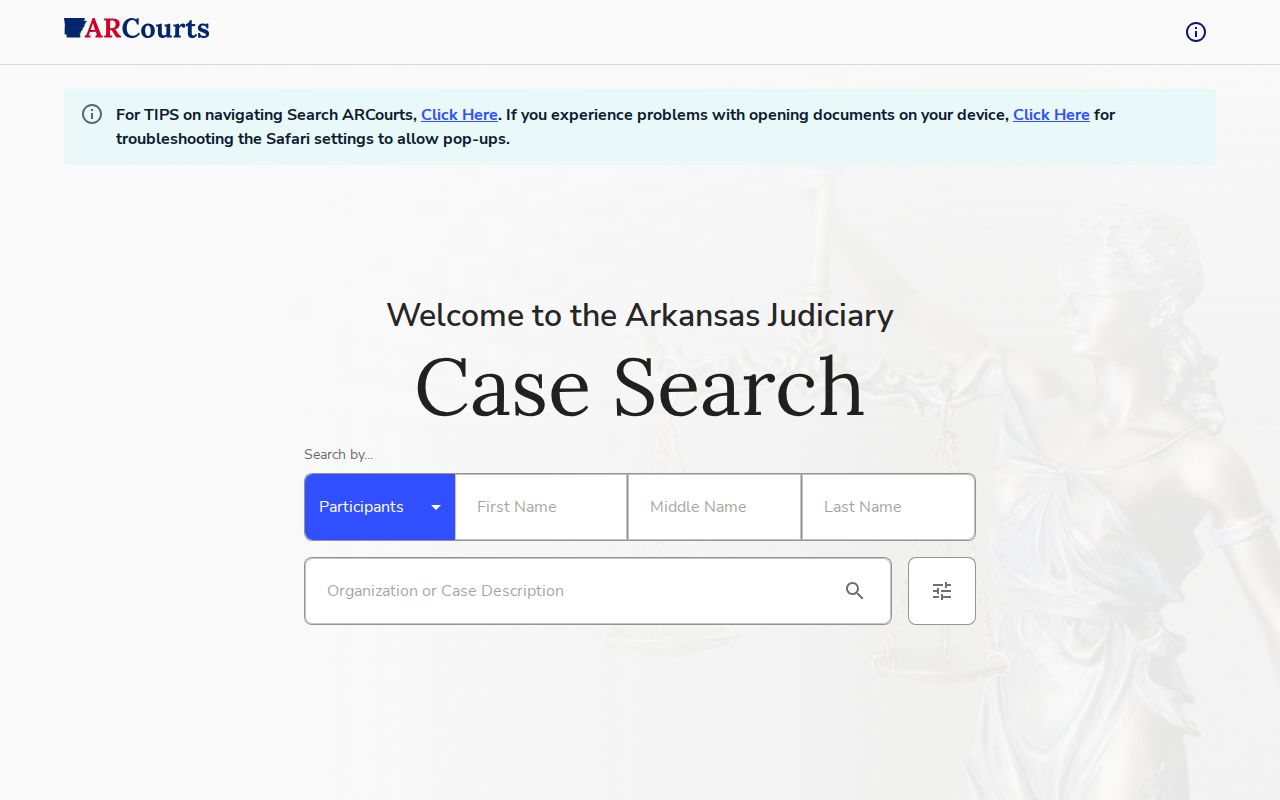
Use the portal to find case information. Then let the issuing Arkansas clerk and the serving agency confirm the warrant's status.
| Channel | What It Covers | Limit |
|---|---|---|
| ACIC / NCIC | Restricted criminal-justice information exchange | Authorized users only; no public name lookup |
| Search ARCourts | Public case and docket information | Not a complete warrant index; District Court coverage varies |
| eTraffic | Citations and payment plans for participating courts | Not warrant status or a statewide license-hold lookup |
| County sheriff page | Records that a local sheriff publishes | May omit other courts and may lag a court update |
| ACC Absconder Search | Supervised-release absconder records | Not ordinary court warrants |
Arkansas Community Correction runs a separate service for supervision questions. It is not a county warrant list. No single table row settles the question for every court.
Warrants in Arkansas: The Main Types
In Arkansas, a warrant name points to a court action. The reason for the order, the case type, and the judge's direction matter more than the wording on a sheriff page. The clerk can explain the order in the case.
| Warrant Type | How It Arises | Who Issues It |
|---|---|---|
| Arrest warrant | Judicial process based on a criminal accusation and statutory probable-cause grounds | Circuit or District Court judge or magistrate |
| Bench warrant | Often follows a missed court appearance or another qualifying court event | The court handling the existing case |
| Failure-to-appear process | Can lead to a warrant and may carry a separate license consequence in some District Court cases | The issuing court |
| Search warrant | Authorizes a search of described places or property; not an arrest lookup | A judge or authorized judicial officer |
| Capias or alias process | Procedural command whose effect depends on the actual order | The court that issued the process |
| Federal arrest warrant | Federal criminal process in a federal case | U.S. District Court judge or magistrate |
Arkansas law and court materials favor three labels: "bench warrant," "arrest warrant," and "warrant for failure to appear." The word "capias" shows up in procedure. It is not a uniform statewide search category. And an Arkansas FTA warrant should not be renamed a capias pro fine.
Arkansas Courts That Issue Warrants
Local warrant questions in Arkansas usually land in one of two trial-court levels. Circuit Court handles felony criminal matters and general-jurisdiction cases. District Court hears traffic, misdemeanor, local-ordinance, preliminary felony, and limited civil matters. The case type points to the clerk, though District Court clerk assignments vary by locality.
| Court Level | Common Matter | Record Route |
|---|---|---|
| Circuit Court | Felony cases, family matters, and juvenile proceedings | Circuit Clerk |
| District Court | Traffic, misdemeanor, city-ordinance, and preliminary matters | Locally assigned court clerk |
| City Court function | Local city-ordinance dockets within the District Court structure | City or District Court clerk, depending on local practice |
The Arkansas Judiciary’s 2026 map lays out the state’s 28 judicial circuits and its 126 Circuit Court judges. District Court is organized differently. It runs on 41 judicial districts staffed by 70 full-time judges. Those are court counts, though, not warrant totals. City Courts folded into the District Court system in 2012, so a warrant lookup may still trace through a city name even though the court itself now sits inside District Court. For a warrant search, the circuit where the case started is the place to point you.
Note: The Circuit Clerk directory covers county Circuit Clerk contacts; District Court clerk arrangements must be confirmed locally.
Arkansas Warrant Records: What They Show
An Arkansas warrant record can take three shapes. It may be the court instrument itself, a docket entry, or an item on a sheriff’s list. Each shape exposes different details. Arkansas uses no statewide warrant-number format or shared status vocabulary, so read any code or number on a county page with that office’s guidance.
| Warrant Number | Local format varies A county or court may assign its own identifier. |
|---|---|
| Subject Name | A name field may help locate a record, but a name match alone is not confirmation. |
| Charge / Offense | The order or case docket may identify the accusation or court matter. |
| Issuing Court | The court name identifies where to ask about the order and next appearance. |
| Bond Amount | A local list may display a bond field; confirm current amount and terms with the court. |
| Status / Return | Served, recalled, or outstanding labels may lag or mean different things across systems. |
A sheriff’s list can show a subset only. You might see a local number, a date, a charge, or a bond. Search ARCourts may list case events without any warrant-status field, so ask the clerk whether a return, a recall, or a new court date appears in the case file.
Arkansas Search Fields Vary
Search ARCourts has two search modes. There is no warrant-status form; the public participant screen offers name, organization, and case-description fields. Case search adds identifiers plus court or county filters. Required markers are not always clear. The portal’s help notes that short names can be treated differently from longer partial matches. That is why each Arkansas form answers a different question. The table compares the public court search and representative county interfaces at the field level, with no person-level query needed, so you can see why one name behaves differently on each form.
| Interface | Observed Inputs | What They Do Not Prove |
|---|---|---|
| Search ARCourts | Participant name and case-description fields; case ID, date range, type, county, and location filters | There is no universal warrant-status field or all-court coverage declaration |
| County name search | Some local pages use first and last name fields | Not statewide; update notices may warn of lag |
| County date-range search | Some local forms accept a warrant number and date range | Its fields do not show coverage of all courts or warrant types |
| eTraffic | Court, name, and citation or identity fields | Payment lookup does not confirm a warrant’s recall |
Use only the fields the official Arkansas court or sheriff requests. Do not send sensitive identifiers to an unofficial search service. If a form finds a case, use the number to ask the clerk about the actual order. A form’s visible fields show how that page searches. Note: those visible fields do not establish which other courts or warrant types its records include.
Arkansas Warrant Status Terms
Arkansas public pages share no single official status dictionary. Check these common words against the docket and the serving agency, especially after a missed hearing or payment.
- Active or outstanding
- A portal label suggesting the order remains open; the issuing court confirms its current status.
- Served
- An officer executed the process and returned it through the court’s procedure.
- Recalled
- The court withdrew the warrant; ask whether the signed order reached the sheriff or other holder.
- Quashed
- A judge set aside the process. Waiting for a website to change is not a substitute for that order.
- Bond forfeiture
- A court process that can follow a missed appearance while released on bond; it may create duties for both the person and surety.
Arkansas readers should ask what a status points to. Is it the underlying case, the warrant, or a later payment? A “closed” case entry alone does not say whether a warrant was served or recalled.
Warrant Record Access Under Arkansas Law
Arkansas keeps agency records and court records under two different access rules. The Arkansas Freedom of Information Act covers eligible public records held by covered agencies. Exemptions apply. Arkansas court records follow a separate track. Administrative Order No. 19, known as AO19, governs them, along with the rules and orders tied to a specific case. So a sheriff FOIA request cannot replace asking the court clerk about a judicial docket. Access can also hinge on execution. Was the arrest warrant executed or returned? Did an Arkansas judge seal the record, or is the file juvenile or otherwise confidential? A public portal may omit information available through a court’s own access process, and some material stays restricted even after a formal request.
Key Rules:
Arkansas Code, §§25-19-101 et seq. - The state FOIA governs access to eligible agency records, subject to exemptions.
Arkansas Rule of Criminal Procedure 7.3 - Arrest-warrant and affidavit access generally follows execution or return, unless the court seals the record for good cause.
Arkansas Rule of Criminal Procedure 13.4 - Search-warrant return materials have separate execution, return, and sealing rules.
Administrative Order No. 19 - Judicial access rules protect sealed, confidential, and sensitive information.
Ark. Code Ann. §9-35-405(j) - Juvenile records generally remain confidential under the new juvenile code.
An online result only locates a record. The issuing Arkansas court decides what may be inspected or copied.
Sealed and Juvenile Warrant Records
Some Arkansas records never appear in a public name search. Rule 7.3 generally opens an arrest warrant and its supporting affidavit once the warrant is executed or returned. A court can still seal it for good cause. An unexecuted order leaves little public trace. So can a sealed indictment or a restricted docket. The court decides whether any part of that record may be released. Juvenile cases sit behind a separate privacy wall. The 2025 Arkansas juvenile code treats juvenile arrest and proceeding records as confidential, with disclosure limited to allowed circumstances. A missing Search ARCourts result is no reason to chase a juvenile record through another channel. For an adult matter, ask the clerk. Ask which public docket or return is available and whether a sealing order applies. Note: public access rules protect case information; they create no statewide warrant list and let no requester bypass a court order.
Arkansas Traffic Holds Follow Another Track
A traffic warrant in Arkansas is a court order in a citation case, while a license suspension is a separate licensing action. Under Ark. Code Ann. §16-17-131, as amended by Act 1049 of 2021, a District Court FTA suspension starts 30 days after the court order, and DFA mails notice. Arrange the matter with the court inside that window. The court then rescinds the order and DFA reinstates the license without a fee. None of this is an Arkansas public name-search tool. eTraffic handles citations and payment-plan accounts for participating courts. It will not search every Arkansas warrant. It cannot confirm that a recall happened either. Before paying, ask whether the court requires an appearance, because some matters cannot be resolved through an online payment. The issuing court can explain the citation, the warrant, and the license order one by one. Arkansas’s statutory code and the etraffic instructions describe different parts of the process. A DFA license-status letter answers a licensing question. It does not clear an Arkansas court warrant. Note: a citation payment, a warrant recall, and a license reinstatement can involve separate records and update at separate times.
Arkansas Warrants Move From Court to Service
An Arkansas warrant begins with a court and a case. A judge or magistrate issues the order under the rule or statute that fits the matter. A clerk records it. The court then sends it to a sheriff or another authorized officer for service. After execution, the officer returns the process. The court logs the next event. If a judge later recalls or quashes the order, the agency holding the service record must get that update. ACIC supplies restricted information services to authorized agencies only, and a holder-of-record agreement can let one agency maintain another agency’s entry. Arkansas publishes no rule showing that every local warrant enters ACIC or NCIC automatically. Arkansas counties do not report every warrant type on one schedule either. One state rule requires NCIC entry for defined categories. That requirement does not add up to universal coverage.
For the reader, the practical sequence is: issuing court → clerk’s case record → serving agency → any authorized restricted-system update. Public web pages can lag. Check the Arkansas court record and the agency responsible for service before relying on an online label.
Arkansas Warrant Technology Timeline
Arkansas built its public tools around the court system, not a public warrant registry. City Courts became District Court departments in 2012. Local court names and clerk assignments still vary. On January 10, 2024, the Judiciary announced the first release of Search ARCourts to replace Public CourtConnect. The launch widened public case access. It did not add an Arkansas warrant-status search. The Judiciary’s release announcement spells out the case-search change, and it creates no public statewide active-warrant database. Arkansas’s system stays layered. Restricted justice data, public case search, citation payment for participating courts, and local warrant records each sit apart. Note: a newer public court-search tool can make a case easier to find without changing who controls the warrant itself.
Resolving an Arkansas Warrant
Only the issuing court can recall or quash an Arkansas warrant. Ask the clerk at that Arkansas court first. Get the case number, the court date, the bond terms, and the agency assigned to serve it. Then ask whether counsel can arrange an appearance, whether a motion is available, and where a person should go. Surrender routes vary across Arkansas counties, so call before you travel. In Arkansas, posting bond secures release or a return date. It does not dismiss the underlying charge. For a missed date, the court may require an appearance, a payment plan, a motion, or other case-specific action. Once the judge acts, follow the paper. Confirm the sheriff received the signed order. Ask whether a separate license record needs an update. Arkansas has no universal statewide recall form, no surrender counter, and no warrant-clearance fee. Local relief events in Arkansas are limited by place, date, court, and eligibility. Pulaski County’s “Get Right With the Court” information describes one county program. Its posted detail may refer to a past event. Confirm current terms on the county’s official notice before making plans, since a temporary event is not statewide amnesty. The county’s event information lays out one local court-resolution route. It is not a statewide warrant service or a case roster.
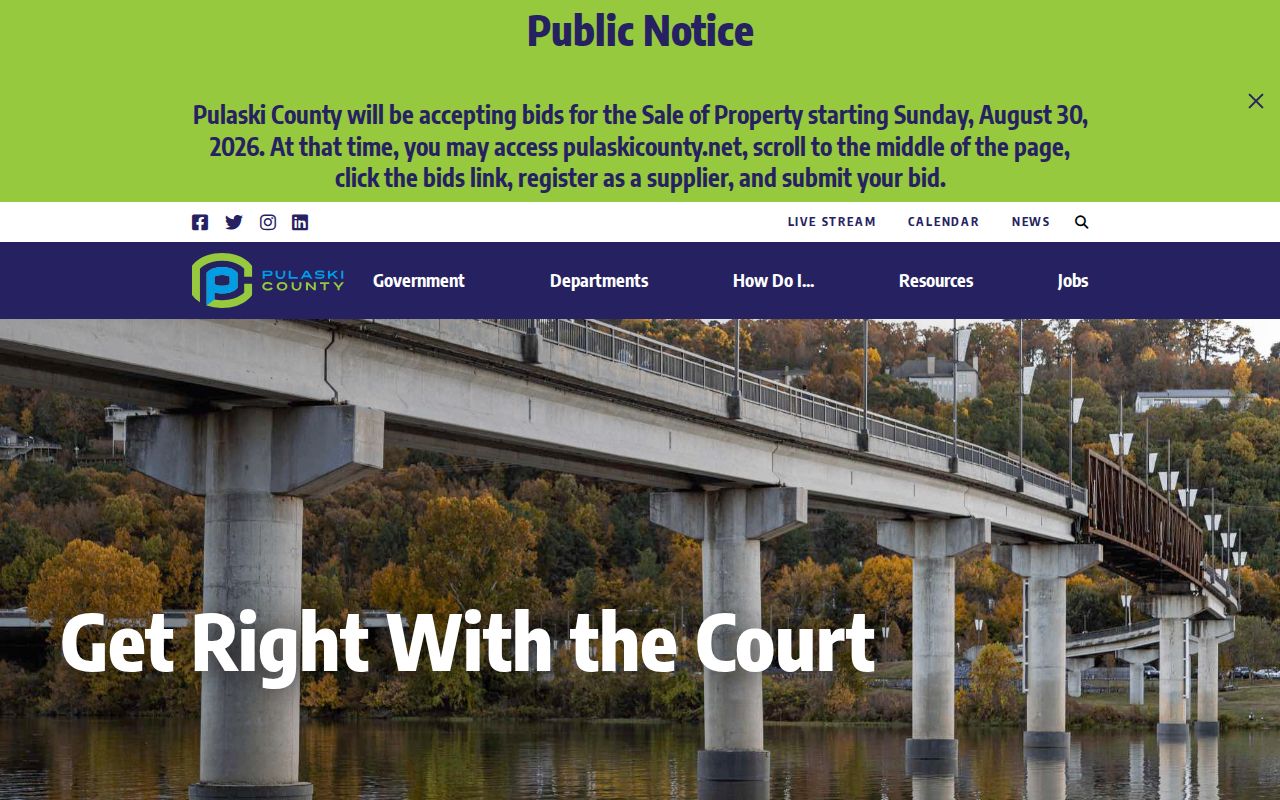
Event terms change, so rely on the county’s current notice. Contact the issuing Arkansas court too. Confirm eligibility, and whether a judge must approve relief. Note: a county event or payment can help with one case, but only the court decides whether its warrant was recalled.
Warrant Records by County in Arkansas
The specific warrant sits with the court that issued it and the county agency responsible for service. Arkansas has 75 counties. Each has a local route to court and sheriff. The largest county pages differ. Some publish a search form, some link a vendor service, and others want a direct call. Start with the county named on the case paperwork.
Pulaski County
Little Rock · State’s largest county population; county District Court posts a local warrant route
Benton County
Bentonville · Northwest Arkansas county; sheriff links a warrant portal and records division
Washington County
Fayetteville · Northwest Arkansas county with a public sheriff warrant search and update cautions
Faulkner County
Conway · Central Arkansas county with an alphabetical sheriff warrant list
Saline County
Benton · Central Arkansas county; use its local court and sheriff contacts
Sebastian County
Fort Smith / Greenwood · Western Arkansas county with a terms-gated sheriff search
Craighead County
Jonesboro / Lake City · Northeast Arkansas county with participating eTraffic courts
Garland County
Hot Springs · Central Arkansas county with a participating eTraffic court
Browse the full directory of all 75 Arkansas counties to reach each county’s local warrant-records route.