
Arkansas Case Search Limits
Search ARCourts, run by the Arkansas Judiciary, is the state's public case-search portal. It is not a statewide warrant database. Coverage varies across District Courts, and no field promises a warrant-status answer, so results depend on what each court posts and its public-access rules. A docket may list hearings and filings while saying nothing about whether an order is still active. As a first clue, though, the portal earns its keep, especially when you do not know which court issued the warrant. It cannot replace a direct call to that court's clerk or to the sheriff who serves its orders. A blank result might mean the court posts no online case data, that your search details differ from the record, or that the file is restricted. It does not prove the warrant is absent. The official Search ARCourts page opens with case-search controls rather than a warrant-status form, and that difference matters when you plan your call.
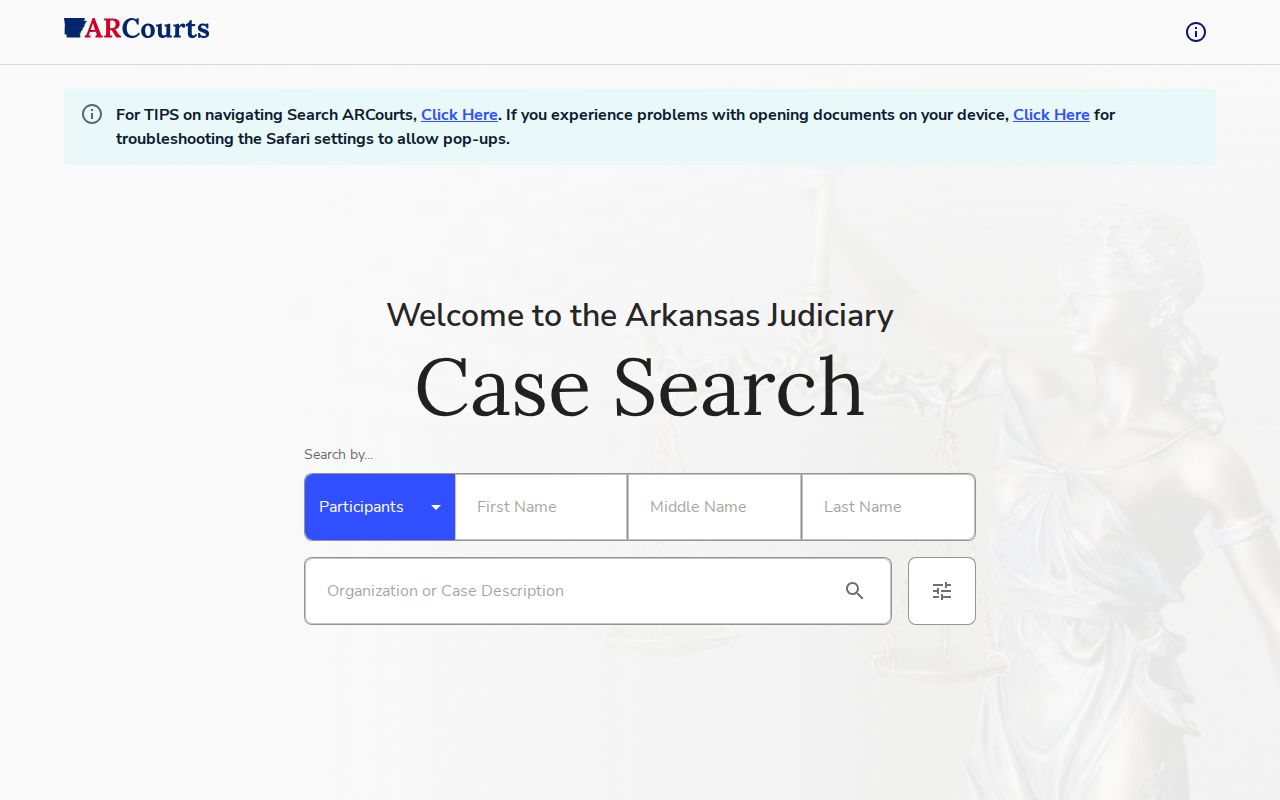
The case-search portal shows public case information only. For any Arkansas warrant question, confirm with the court that issued the order.
Arkansas Warrant Searches
Arkansas has no verified public statewide active-warrant lookup. Start with public court-case information instead. Then check the county sheriff's official channel in that Arkansas county, where one exists. A sheriff search covers only what that office publishes. It does not merge every Circuit Court, District Court, city-court department, or neighboring county order into one result. Before you search, gather the person's full legal name, approximate date of birth, county, court, and any citation or case number shown on prior papers. Use personal details only on an official source or when speaking with the court. An unfamiliar docket can be hard to read. An Arkansas attorney can interpret it and discuss next steps before an appearance.
- Use Search ARCourts to look for a public case by participant name or case and citation details. Treat any result as a case lead, not a warrant confirmation.
- Read the docket for the court name, case type, filing history, and listed hearing information. Search with likely name forms if the official tips suggest the first query may be too narrow.
- Open Browse Counties and select the county connected to the case. Check that sheriff's official warrant channel or contact its records or warrant unit.
- Contact the issuing District Court clerk for traffic, misdemeanor, or city-ordinance matters, or the Circuit Clerk for a Circuit Court case. Ask about status and the required next step.
- Ask the sheriff or serving agency to confirm whether it holds the order. If a warrant is confirmed, consult counsel and follow the court's appearance, bond, or recall instructions.
A traffic warrant is a separate question from your license. eTraffic serves only participating courts. It handles citation or payment-plan queries, not general warrant searches. Supervised release runs through its own Arkansas Community Correction channel.
Arkansas Name Search Behavior
Search ARCourts, the Arkansas public portal, gives you two modes. Participant search fields cover first, middle, and last name, organization, and case description. Case search takes a case or citation identifier, a filing-date range, case type, docket code, county, and court location. Arkansas shows no required-field markers on the public form, so treat no field as mandatory statewide. The official Arkansas Judiciary search tips page explains how names are matched. Short names can be treated as exact matches. Longer names can match exactly or in part. Alias records may appear as well. A middle-name query can return more broadly than you expect. When an Arkansas search fails, review spelling and name variations. Do not assume every alias, nickname, or older case is indexed. These behaviors help you find an Arkansas case, not confirm warrant status, so compare the court, case type, and details you know. Then ask the court clerk to verify the record. A common-name match alone is not enough to act on.
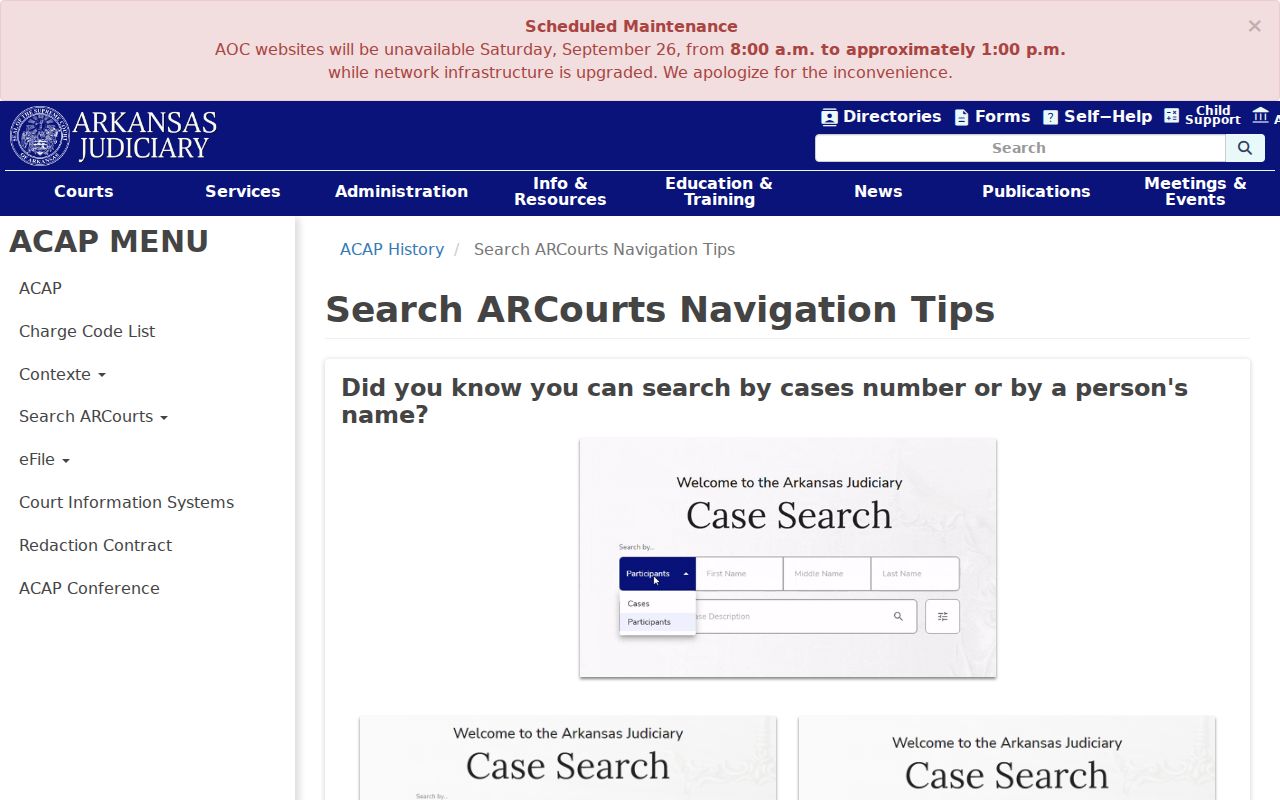
The help screen lists case-search options, not warrant status. An empty Arkansas name search is not proof; ask the issuing court and sheriff whether another local record or order exists.
What an Arkansas Warrant Search Asks For
Arkansas publishes no public statewide warrant form. The table lists the official public case-search fields used to locate the underlying court file. They do not search ACIC/NCIC. They return no uniform warrant record. Search ARCourts separates a person search from a case search, so the most useful field depends on what you already know.
| Field Label | Type | Required | Notes |
|---|---|---|---|
| First, Middle, Last Name | Text | Unspecified | Participant search; short-name matching may be exact and longer names may match partially. |
| Organization or Case Description | Text | Unspecified | Additional participant-search fields, not a warrant category. |
| Case or Citation ID | Text | Unspecified | Useful when it appears on a ticket, notice, or court paper. |
| Filing Date Range | Date range | Unspecified | Part of case search; does not show a warrant's date or current status by itself. |
| County and Court Location | Search controls | Unspecified | Helps narrow a case search; the portal does not claim every District Court participates. |
Case mode adds case type and docket code controls. The public Arkansas form shows no required-field markers. Keep sensitive information off unofficial search sites that copy court names or records.
Arkansas ACIC Is Restricted
The Arkansas Crime Information Center runs a closed network for law enforcement. The public cannot search a personal name there. ACIC and NCIC access belongs to authorized justice users only, and the agency states that protected criminal-justice information is never released through a public FOIA request. Even a public case does not open it. Search ARCourts sits on a different layer. It publishes selected public case information for anyone to read. ACIC/NCIC serves justice agencies instead. No public searcher can ask Arkansas ACIC to certify that a local warrant is absent, active, served, or recalled. A records request will not change that either. Arkansas keeps these doors separate by design. Pull the public docket and identify the issuing court. Then take the question to that Arkansas court and to the county sheriff, who can speak to service. Because case access and restricted police data never merge, an online search alone cannot clear the question.
Arkansas Warrant Search Results
A Search ARCourts hit is a case record. It is not a standard warrant result. Arkansas publishes no statewide format for these answers. Depending on the court, the public view may show parties, case identifiers, filings, events, charge information, or links to public documents. No schema promises a warrant number. Bond amounts, execution status, and recall dates are not guaranteed fields either. Sheriff lists differ again, and the fields vary by county. Treat a case result as a lead. Use it to identify the court and the matter. Then ask the clerk what the current docket means for your Arkansas case. A label like "closed" or "disposed" can describe the case or a payment event, not the warrant itself. "Served," "recalled," or "cleared" still deserves a call to the issuing court, since the public portal may lag the official action.
| Warrant Number | No statewide format A local court or sheriff may assign or display an identifier; no common public Arkansas format was verified. |
|---|---|
| Case Information | Search ARCourts may show public case identifiers, participants, docket entries, and documents according to court access settings. |
| Charge or Offense | May appear in a public case or local sheriff record; ask the clerk for the actual order or charge copy. |
| Issuing Court | Use the court name and location to reach the clerk that maintains the case. |
| Bond or Conditions | Not guaranteed in a search result. Confirm bond, appearance, or release terms directly with the court or serving agency. |
| Current Status | No statewide status field exists in the public case-search portal. Ask whether the order remains open and whether a recall reached the sheriff. |
For more on local status labels and confirmation steps, see Active Warrant Search.
Arkansas eTraffic Is Limited
The eTraffic Citation Query lets you search or pay a citation in a participating Arkansas court. The official list shows 45 participating court entries. Participation can change. The citation form asks for a selected court plus a name with a citation number, or a driver-license or state-ID number with a date of birth. It is a payment workflow, not an Arkansas warrant search. A separate query looks up an existing payment plan. Neither form confirms every warrant or every court. Neither tells you whether a judge requires an appearance. Paying a balance online may not settle a separate warrant or license action, so call the issuing court if a missed date or installment may have started court process. A license suspension is its own animal. DFA license records speak to license status only. They do not certify whether an Arkansas court issued or recalled a warrant. Keep each question with the agency that holds that record. For supervised release, the Arkansas Community Correction Absconder Search covers absconder records, not general court warrants. PACER can locate public federal cases. Sealed or unfiled warrants may not appear there.
Arkansas Warrants: Who Holds What
The issuing court controls the case and its orders. Circuit Court handles Arkansas felony cases and other matters in its jurisdiction, with Circuit Clerks keeping those case records. District Courts take many traffic, misdemeanor, and local-ordinance matters. Clerk arrangements there vary by location. In many places, city courts became Arkansas District Court departments. Ask the court that issued the order what it means. The sheriff receives process and tracks service. So both offices hold pieces of the answer. Search ARCourts can locate some public Arkansas case records, and a sheriff portal may expose a local list. ACIC/NCIC stays restricted. These sources serve different functions. They never merge into an Arkansas warrant check. Start with your county's court and sheriff contacts when the case is local or the online record is unclear. The official Circuit Clerk directory routes a Circuit Court question. For an Arkansas District Court matter, use that court's own clerk contact rather than assuming the Circuit Clerk holds every lower-court file. Pulaski County District Court publishes one local warrant-resolution route whose instructions show why the issuing court and sheriff both matter, though the steps apply only to that county's cases.
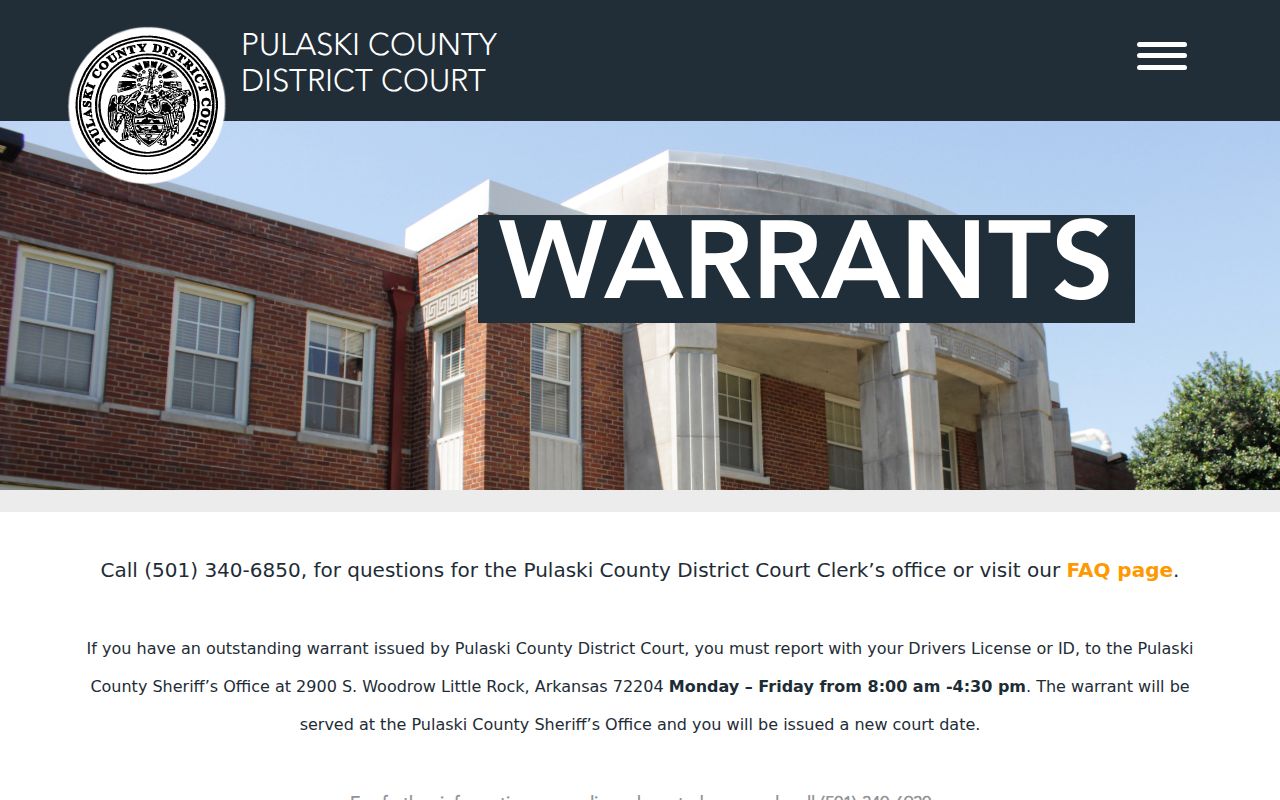
This page describes one county's local process only, and other Arkansas courts may require a different contact or appearance step.
Arkansas Warrant Records Access
Arkansas opens its agency records through the Arkansas Freedom of Information Act, but court files answer to a different set of rules. Those follow Arkansas Supreme Court Administrative Order No. 19 and the court access rules. A sheriff's records request and a request to inspect a judicial file are therefore two separate errands. Ask the Arkansas office that actually holds the record. Name the case and the document. Then ask about inspection, copy costs, redactions, and timing. No request gets you past a sealed record, juvenile confidentiality, or restricted law-enforcement data. Active investigations and court orders can also limit what comes out. Arkansas sets no statewide warrant-request form. No fixed fee or processing promise exists either. If the online result is blank, ask the clerk whether the record is public. A paper file or a copy may still be an option. For a sheriff-held record, use that office's FOIA contact. For a judicial case file, ask the court clerk under AO19. The Attorney General's FOIA guidance explains the agency-record framework, but it is not a personal ACIC search channel.
Which Arkansas Warrants Stay Restricted
Access in Arkansas turns on the record, the rule, the statute, and any sealing order. Arkansas Rule of Criminal Procedure 7.3 generally makes an arrest warrant and its supporting affidavit public after execution or an unexecuted return. The court can still seal the file. It needs good cause. That timing rule does not give you a live statewide warrant search in Arkansas. Ask the issuing court whether the file is public and whether the warrant has been returned.
Access rules:
AO19 restricts sealed and confidential court material. A warrant not visible online may be restricted, held by a court without portal access, or absent from the search for another reason.
Juvenile records are generally confidential under Arkansas law and are not ordinary public adult warrant results.
ACIC/NCIC information is restricted to authorized criminal-justice users. A public FOIA request does not provide a self-search.
A blank search result is no proof. Confirm with the issuing court and the county sheriff in Arkansas. An attorney can also help with restricted-access questions or how to address an active order.