
How Arrest Warrants Work in Arkansas
An Arkansas arrest warrant tells an officer to take a named person into custody. Under Ark. Code Ann. §16-81-104, a judge or magistrate issues one on personal knowledge or on sworn information showing reasonable grounds. A prosecutor can file sworn written information. An investigator's request alone creates nothing. The call belongs to the judicial officer. The statute sets a statewide framework, yet the case stays with the Circuit Court or District Court that issued the order. Felony cases usually run through Circuit Court. Its Circuit Clerk keeps that docket. Traffic, misdemeanor, ordinance, and preliminary felony matters may sit in District Court under a local clerk arrangement. Before trusting a general county list or a statewide case-search result, find the case court in Arkansas. That court confirms the warrant.
Arkansas Arrest Warrant Grounds
Section 16-81-104 lets a judge or magistrate issue an Arkansas warrant on personal knowledge or on sworn information establishing reasonable grounds, and a prosecutor can supply that sworn information. It is a judicial review step, not a public online application, and no complaint guarantees an arrest warrant. The exact charging record and order control.
Arkansas Code: Ark. Code Ann. §16-81-104 describes who may issue the warrant, the required offense and county description, the arrest command, and the direction to bring the person before a judicial officer.
The Arkansas Rules of Criminal Procedure also govern criminal process. Read the rule beside the case record. A short docket label alone rarely explains the full basis for an Arkansas warrant.
Arrest Warrants: What They Contain
Arkansas law requires the warrant to describe the offense and the county, command the arrest, and direct the officer to bring the person before a judicial officer. It must state the charge. It must name where the case belongs. A local court record may carry extra case fields beyond those basics. The state sets no single warrant-number format and no standard public status code, and county forms differ in Arkansas. The court's own record settles the match of person, charge, and case. An online list may give just a name. Ask the clerk whether a public copy of the warrant or its return exists. In Arkansas, statutory contents and local case detail are not the same thing.
| Offense | The offense described in the warrant; compare it with the complaint or public docket. |
|---|---|
| County | The county identified in the instrument, which helps route the reader to the issuing court. |
| Command | An instruction to arrest the named person. |
| Appearance | A direction to bring the person before a judicial officer. |
| Warrant number | Arkansas has no verified statewide number pattern; use the local docket or clerk’s record. |
| Status and return | No statewide public status codes were verified; ask the issuing clerk and serving agency for current information. |
Arkansas Arrest Warrant Access Under Rule 7.3
Arkansas Rule of Criminal Procedure 7.3 generally opens the warrant and its supporting affidavit to the public once the officer executes or returns it. Sealing for good cause can close the record again. AOC warrant-docket guidance in Arkansas keeps handling restricted before return and moves the matter to the public docket after return. The rule governs access at a procedural stage. It promises no public portal for every active Arkansas warrant. The official criminal rules index lists Rules 7.1 through 7.3, and the AOC warrant-docket procedure explains handling before and after return. A court may still seal particular records for good cause. Other rules and confidentiality protections can apply. A missing docket entry has several explanations. Ask the clerk whether the Arkansas record is pre-return, sealed, or held in a court system that is not online.
Note: A returned warrant can be public under Rule 7.3 while the court still seals particular records for good cause.
How Warrants Get Served in Arkansas
Ark. Code Ann. §16-81-104 lets any authorized law-enforcement officer execute an arrest warrant anywhere in Arkansas. The serving agency varies with the order and case. A county sheriff may serve the order and maintain local warrant records. Municipal police often handle city or District Court process. Arkansas State Police may assist with state investigations or joint operations. No single agency handles every Arkansas warrant. Service and court status are separate records. The officer reports execution or nonexecution through the process the case requires. The issuing court keeps the docket. It also decides bond and any further appearance terms. With paperwork in hand, ask the clerk which agency received the warrant, then ask that agency about service status and return information. A recall from an Arkansas court needs to reach that agency too.
Note: A court docket entry and an agency's service record can show different stages of the same Arkansas warrant process.
A Sealed Arkansas Warrant May Stay Hidden
A blank result proves very little. Arkansas has no statewide online registry of active arrest warrants, and Search ARCourts was built for case lookup, not warrant confirmation. Some District Courts sit outside its public coverage. A sealed record or juvenile matter may never surface there at all. A pre-return warrant can stay out of view until the court acts on it, and a sealed indictment keeps charging details off the public docket until a later step opens the file. The restricted side of the system works differently. ACIC and NCIC indexes are limited to authorized criminal-justice users, and the Arkansas Crime Information Center FAQ states that this restricted information is not released to the public through FOIA. No self-check form exists for those systems in Arkansas. A case-search portal, a sheriff portal, and a restricted law-enforcement index each do a different job. Treat none of them as a complete statewide warrant list. For a court file, ask about Arkansas Supreme Court Administrative Order No. 19 (AO19) and any sealing limits that apply. A FOIA request to a sheriff can surface records the agency holds. It still cannot tell you whether an Arkansas court considers the warrant live; only the issuing court can answer that. Juvenile records carry extra confidentiality protections of their own.
Arrest Warrants, Summonses, and Bench Warrants
These three labels mark different steps in an Arkansas case. An arrest warrant comes after judicial review of an accusation and commands that a person be taken into custody. A summons simply directs someone to respond to a case, with no arrest command attached. A bench warrant usually follows a missed court date or a problem with release conditions. For the court-date side of the process, see Arkansas bench warrant lookup.
| Process | Purpose | Typical next step |
|---|---|---|
| Arrest warrant | Authorizes arrest after the required judicial process | Confirm charge, issuing court, service, and first-appearance terms |
| Summons | Calls a person to respond to a case | Follow the stated date and court instructions |
| Bench warrant | Addresses a missed obligation or another court-authorized trigger in an existing case | Ask the issuing court whether appearance, recall, or bond is required |
A label alone answers very little. It will not show whether an Arkansas case is sealed, whether bond has been set, or which agency holds the service assignment. Ask the clerk for the actual order and the next required action in the case.
Who Serves an Arkansas Arrest Warrant?
Authority to execute an Arkansas warrant runs statewide. The actual work follows the order and the agency assignment. A sheriff may receive a county warrant. City police can serve municipal or District Court process. The Arkansas State Police may join investigations or a fugitive task force, and the U.S. Marshals Service handles federal warrants through its federal courts and district offices. No state sheriff portal can confirm every federal or state matter, so ask the issuing court which agency received the warrant first. Then ask that agency directly whether service or return has a current status. If the court says a warrant was recalled, confirm the serving agency got that order. Arkansas publishes no statewide update schedule, so a court entry and an agency system may lag each other by some time. Note: federal questions belong with the federal court or the U.S. Marshals district, not with an Arkansas county sheriff's record desk.
Arkansas Arrest Warrant Cases Through the Clerk
Search ARCourts is the statewide starting point for finding a public case and naming the court that holds it. The portal does not promise a warrant-status field. Its name-search instructions help with case lookup, nothing more, and they do not turn the site into a warrant confirmation service. Enter a case number or citation if you have one. Check which court tier the case sits in before you call. Circuit cases belong with the Circuit Clerk. Traffic, misdemeanor, and local-ordinance matters go to the District Court or its designated local clerk. Ask for the warrant issue date, the charge, the case number, the return or current docket status, and any bond terms. Ask as well whether the court can provide a public copy. If the Arkansas record is sealed or missing from online coverage, ask the clerk what public information remains available and let the court speak for the case.
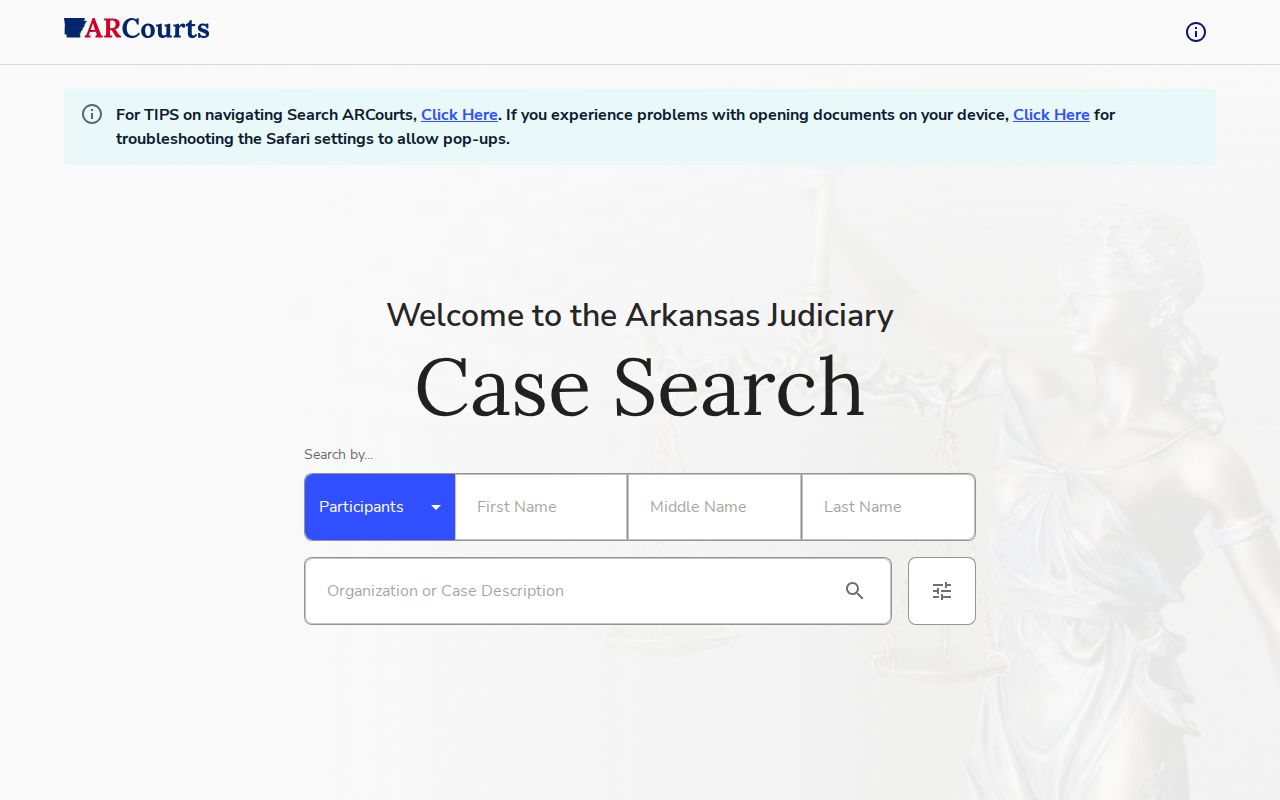
Search ARCourts is a public case-search entry point, not an arrest-warrant result. A direct clerk confirmation is still how you get current warrant status in Arkansas.
Handling an Arrest Warrant in Your Name
Think an Arkansas arrest warrant carries your name? Confirm the case with the issuing court first. Learn which agency holds it. A lawyer can contact the court or prosecutor, arrange a voluntary appearance, and advise whether a motion or bond hearing fits your situation. Treat any public search result with care. It may be stale, thin, or cut off by a seal, and a missing result is no clearance. Ask the clerk what charge and order are involved, whether bond is set or needs a judge, where an appearance must happen, and whether the sheriff or another officer has received a recall. Posting bond can secure release. It does not dismiss the criminal case. The $50 sheriff service fee under Act 693 applies only within its specified judgment context, so it is not a general arrest-warrant fee in Arkansas. The court controls the case, while the executing agency keeps its own service record. Find the local court and sheriff through the Arkansas county directory.
Important: Confirm the warrant and bond terms with the issuing court or counsel before arranging an Arkansas surrender; online case access cannot change the order.
Arkansas Arrest Warrant Surrender Steps
Arkansas has no statewide walk-through desk and no universal pre-arrest surrender form. Local practice varies from county to county, and some warrants require a judge to set bond rather than allowing a surety shortcut. Call before you travel. Talk to the issuing clerk and to the sheriff or agency assigned to service. Ask whether counsel can arrange a date, what identification or case information to bring, where to report, and what written terms will follow. The Pulaski County District Court warrant instructions show one county's route for confirming and handling District Court warrants. They are a local example, not a template for every Arkansas court. Other counties may send people to a clerk, a judge, the sheriff, the jail, or a counsel-coordinated appearance instead. Use the county directory to reach the right local contact, and get the next court date plus any receipt or order in writing before you leave.

For surrender steps on an Arkansas arrest warrant, call the issuing court's clerk and ask what the assigned agency expects. Arkansas leaves the details to each county. Note: Arkansas has no statewide pre-arrest surrender desk and no universal bond shortcut.